Cold Email Benchmarks 2026: The Complete Data-Backed Guide



Contents
Understanding your cold email benchmarks in 2026 separates guesswork from growth. Without clear, data-backed performance targets, you’re flying blind: spending hours on outreach that may be quietly underperforming while competitors quietly steal market share with campaigns that convert at two, three, or even five times your rate.
This guide gives you the exact numbers you need to measure your cold email performance across SaaS, agencies, and professional services. You’ll learn where the median sits, what the top 10% do differently, and how to diagnose (and fix) underperformance at every stage of the funnel. Every benchmark here ties to real 2026 data so you can set goals that actually mean something.
2026 Cold Email Benchmarks by Industry
Industry context matters enormously when evaluating outreach performance. A 3% reply rate might signal excellence in enterprise SaaS but mediocrity in a local services campaign targeting small business owners. The benchmarks below reflect 2026 data aggregated across millions of sends, segmented by vertical.
According to the 2026 Benchmark Report, the average reply rate across all industries sits at 3.43%. However, that single number hides massive variation. Meanwhile, an analysis of over 1.37 million cold emails found a 2.09% average reply rate, underscoring why you must compare like-for-like methodology when benchmarking your own numbers.
SaaS and Technology Benchmarks
SaaS outbound remains one of the most competitive cold email verticals. Buyers receive dozens of pitches weekly, and inbox fatigue drives down engagement. For 2026, here’s where the numbers land for SaaS senders targeting mid-market and enterprise accounts.
| Metric | Below Average | Average | Good | Elite (Top 10%) |
|---|---|---|---|---|
| Open Rate | <30% | 30–45% | 45–60% | 60%+ |
| Reply Rate | <1.5% | 1.5–3% | 3–5% | 5%+ |
| Positive Reply Rate | <0.5% | 0.5–1.5% | 1.5–3% | 3%+ |
| Meeting Booked Rate | <0.3% | 0.3–1% | 1–2% | 2%+ |
| Bounce Rate | >5% | 3–5% | 1–3% | <1% |
SaaS senders who target SMBs typically see reply rates 20–40% higher than those targeting enterprise, largely because enterprise prospects have more aggressive spam filters and fuller inboxes. If you’re selling a $50K+ ACV product, benchmark against the lower end of “good” rather than general averages.
Agency and Consulting Benchmarks
Agencies (marketing, design, development) tend to outperform SaaS in raw reply rates because their offers are often more immediately tangible. A “free audit” or “we noticed X on your site” angle creates curiosity that software demos rarely match. Agency senders in 2026 typically see average reply rates between 2.5% and 4.5%, with elite performers breaking 7%.
The key differentiator for agencies is personalization depth. Generic “we help businesses like yours” messaging performs at or below the SaaS average. Agencies that reference specific client work, competitor examples, or publicly visible problems consistently land in the top quartile.
Professional Services Benchmarks
Professional services firms (legal, accounting, HR, financial advisory) operate in a unique space where trust signals matter more than clever copy. Open rates tend to run higher (40–55% average) because sender credibility is often stronger, but reply rates cluster around 2–3.5% because the buying cycle is longer and more relationship-dependent.
For services firms, the metric that matters most isn’t reply rate but meeting-to-opportunity conversion. Elite services firms convert 30–40% of booked meetings into qualified opportunities, compared to 15–20% for average performers. Your cold email benchmarks should extend beyond the inbox into these downstream metrics.
What Separates Top 10% Cold Email Performers
Average senders focus on volume. Elite senders focus on precision. After analyzing performance data across verticals, a clear pattern emerges: the top 10% don’t just write better emails. They operate fundamentally different systems.
Hyper-Segmentation and List Quality
The single biggest performance lever isn’t your subject line or copy. It’s who you’re emailing. Top performers build micro-segments of 50–200 highly qualified prospects rather than blasting lists of 5,000+. They verify every email address, research each company’s current situation, and only reach out when a genuine trigger event (funding round, new hire, product launch) creates a relevant opening.
Verified Email’s analysis of B2B email marketers found that clients who applied deep segmentation and deliverability fixes saw their best-performing quartile top 50% open rates, 6–10% CTR, and generate $36–$42 in revenue for every $1 invested. That’s a 4–5x lift over other channels, and it starts with list quality.
Deliverability Infrastructure as a Competitive Edge
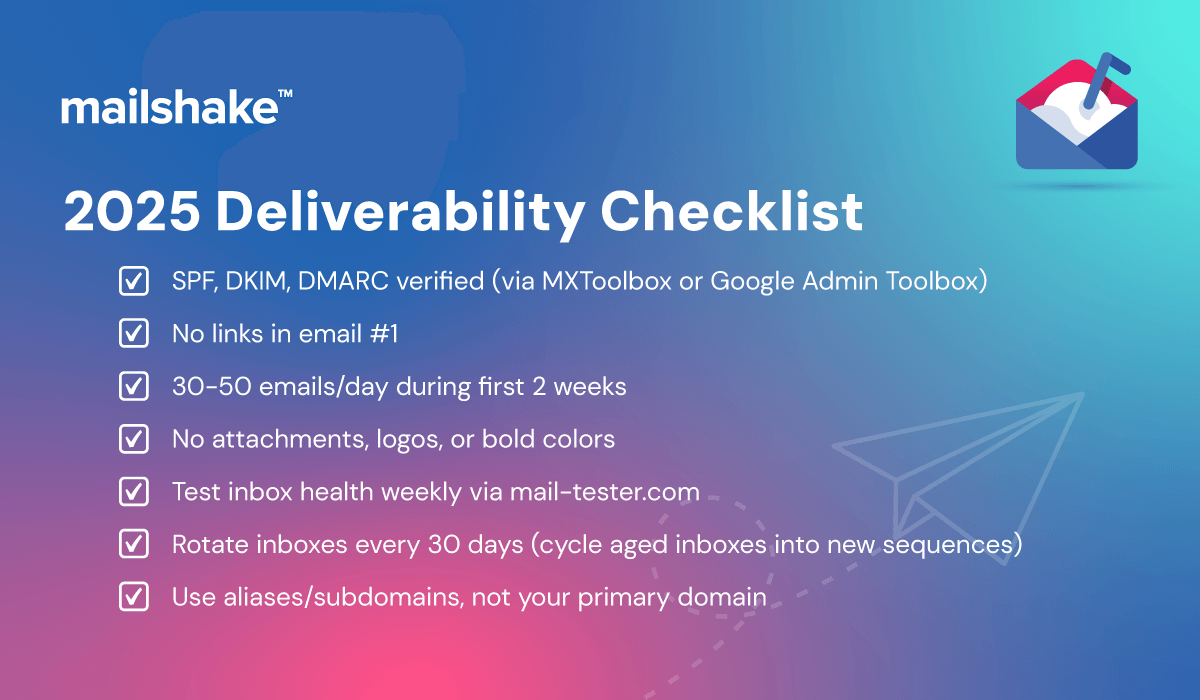
Elite senders treat deliverability like a product, not an afterthought. Their technical setup includes properly configured SPF, DKIM, and DMARC records, dedicated sending domains (never their primary domain), and systematic warm-up protocols. They limit daily send volume to 30–50 emails per mailbox and rotate across multiple inboxes to maintain sender reputation.
The average sender skips warm-up, sends from a single domain, and wonders why open rates crater after week two. If your open rate drops below 25% on a previously healthy domain, deliverability degradation is almost certainly the cause. Tools like Mailshake’s email domain setup assistant and free warm-up features help teams build this infrastructure without requiring technical expertise, getting new reps sending on day one with properly warmed mailboxes.
Copy That Earns Replies, Not Just Opens
Top performers write emails that read like messages from a real person, not marketing templates. Their emails average 50–90 words (compared to 150+ for average senders), lead with a specific observation about the prospect, and close with a low-friction question rather than a calendar link.
The pattern looks like this: one sentence establishing why you’re reaching out (tied to something specific about them), two to three sentences on what you do and why it’s relevant right now, and one question that’s easy to answer. No walls of text. No feature lists. No “just circling back” follow-ups. Every touch in the sequence adds new information or a new angle.
How to Diagnose Cold Email Underperformance
Knowing the benchmarks is step one. Knowing what’s broken when you fall short is where the real value lies. Use this diagnostic framework to pinpoint exactly where your funnel leaks and what to fix first.
Step 1: Audit Your Open Rates
If open rates fall below 30%, the problem is almost always deliverability or sender reputation, not your subject lines. Check these in order:
- Authentication records: Confirm SPF, DKIM, and DMARC are properly configured on every sending domain
- Warm-up status: New domains need 2–4 weeks of gradual volume increase before full sends
- Bounce rate: If bounces exceed 3%, your list quality needs immediate attention
- Spam complaints: Anything above 0.1% signals a dangerous trajectory that will tank deliverability
Only after confirming clean infrastructure should you test subject lines. When deliverability is healthy and open rates still lag, test shorter subject lines (3–5 words), remove all caps and special characters, and personalize the preview text.
Step 2: Evaluate Reply Rates Against Your Cold Email Benchmarks
If open rates are healthy (40%+) but reply rates sit below 2%, the problem lives in your messaging, targeting, or both. Work through this checklist:
- Relevance check: Does your email mention something specific to the prospect’s company, role, or industry within the first two sentences? Generic pitches consistently underperform by 60–70%.
- Offer clarity: Can the reader understand what you’re offering and why it matters to them in under 10 seconds? If your email requires scrolling on mobile, it’s too long.
- CTA friction: “Are you open to a 15-minute call?” converts significantly better than “Book a demo at this link.” Lower the commitment threshold.
- Sequence depth: Most replies come from follow-ups 2–4, not the initial email. If you’re only sending one or two touches, you’re leaving meetings on the table.
Designmodo’s 2026 research showed that teams who aligned goals to updated benchmarks spotted 4.34% bounce-rate issues early and corrected list hygiene to lift opens to the 29.9% industry average within one quarter. The lesson: regular benchmark comparison catches problems before they become crises.
Step 3: Trace Downstream Conversion Gaps
If replies are strong but meetings don’t materialize, the disconnect typically sits in your response handling or qualification process. Top teams respond to positive replies within 60 minutes during business hours. They use a dedicated lead management workflow to route replies immediately rather than letting them sit in a shared inbox.
Track your full funnel weekly: sends, opens, replies, positive replies, meetings booked, and opportunities created. Without this end-to-end visibility, you can’t tell whether you have a messaging problem or a sales process problem. Most underperformance that looks like a cold email issue is actually a speed-to-lead issue.
Building a Measurement System That Drives Improvement
Benchmarks only matter if you measure against them consistently. Forrester Research recommends building what they call a “measurement-centered culture,” where teams start with disciplined data selection and hygiene so that cold email KPIs become actionable business metrics. Firms adopting this framework reduced orphan KPIs by 40% and re-allocated budget toward channels with provable revenue impact.
Here’s how to put this into practice for your outreach program. Focus on five core metrics, reviewed weekly:
- Inbox placement rate (not just “delivered”), which tells you whether emails actually reach the primary inbox
- Unique open rate (filtered for bot opens), giving you a true engagement signal
- Positive reply rate (excluding auto-replies and “not interested”), the clearest indicator of message-market fit
- Meeting booked rate per 100 emails sent, connecting outreach effort to pipeline
- Revenue per 1,000 emails, the ultimate benchmark that justifies your program’s existence
Strip away vanity metrics like raw send volume and total open counts. These create the illusion of progress while masking real problems. The teams that consistently hit elite cold email benchmarks are the ones who track fewer metrics but act on them faster.
Your 30-Day Cold Email Benchmarking Sprint
Reading benchmarks is easy. Operationalizing them requires a structured approach. Use this 30-day sprint to establish your baseline, identify gaps, and start closing them.
Week 1: Audit your current infrastructure. Verify authentication records, check domain reputation scores, and confirm your warm-up protocol. Document your current metrics across all active campaigns. This is your baseline.
Week 2: Compare your baseline to the industry benchmarks in this guide. Identify your biggest gap: deliverability, open rates, reply rates, or downstream conversion. Focus all optimization energy on that single gap.
Week 3: Run targeted experiments. If deliverability is the gap, set up additional sending domains and implement proper warm-up. If replies are the gap, A/B test two completely different messaging angles (not just subject line tweaks). If conversion is the gap, implement a sub-60-minute response protocol.
Week 4: Measure results against your Week 1 baseline. Document what moved the needle. Set your go-forward benchmarks based on actual performance data, not industry averages. Your own trajectory matters more than anyone else’s median.
Cold email still delivers outsized ROI for teams willing to approach it with discipline, data, and genuine relevance. The difference between average and elite isn’t talent or luck. It’s systematic measurement and rapid iteration. Platforms like Mailshake make this process repeatable by combining sending infrastructure, deliverability tools, AI-powered copy creation, and the Lead Drivers dashboard into a single workflow, so you spend less time stitching tools together and more time optimizing what matters.
Start your benchmarking sprint this week. Pull your numbers, compare them to the data in this guide, and fix the biggest gap first. That single action will put you ahead of 90% of senders still guessing their way through outreach.
Frequently Asked Questions
How many prospects should be in each segment to keep personalization practical at scale?
Aim for segments that are small enough to support consistent research, but large enough to produce learnings quickly. If personalization quality drops or reps start copying and pasting, the segment is too broad and should be split by role, use case, or trigger.
What is a reasonable follow-up schedule that increases replies without feeling spammy?
Use a short sequence that varies both timing and message angle, for example, a quick nudge, a value add, then a final close-the-loop note. Stop early when someone signals no interest, and avoid sending multiple emails in the same day unless the prospect is actively responding.
How do I handle auto-replies, out-of-office messages, and role-based inboxes in reporting?
Classify them separately so they do not inflate reply and positive reply rates. For out-of-office responses, set a reminder to re-engage after the return date, and for role-based inboxes, track whether they route to a real buyer or a gatekeeper.
What should I do when open tracking is unreliable due to privacy features and bot activity?
Treat opens as a directional signal and validate engagement with replies, clicks, and downstream outcomes. Use unique open rate filtering, add lightweight link tracking where appropriate, and prioritize inbox placement and positive replies as stronger indicators of performance.
How can I choose the right call to action for different personas and deal sizes?
Match the CTA to the buyer’s risk level and time constraints, then escalate only after interest is confirmed. For higher stakes deals, start with a simple question that validates fit, then move to scheduling once the prospect acknowledges the problem or priority.
What are best practices for compliant cold email when prospecting internationally?
Document a lawful basis where required, include clear identification, and provide an easy opt-out in every message. Because rules vary by region and by whether you target individuals or businesses, align your process with counsel and keep auditable records of consent, suppression lists, and data sources.
How do I connect cold email performance to pipeline and revenue without messy attribution?
Define a consistent attribution rule set, such as first touch, last touch, or a simple multi-touch model, then apply it the same way across campaigns. Use CRM timestamps and standardized lifecycle stages so meetings, opportunities, and closed-won revenue can be traced back to the originating sequence and segment.


Continue reading





Social


